|
Monitor wild
Dolphin and Whale populations along the coast of Mauritius and make a
vital contribution to the work of a local NGO. You'll help raise
awareness about the impact of tourism on these species, aiming to ensure
a sustainable future for all. This fantastic research opportunity would
suit anyone with a love of the outdoors and a passion for marine life.
"My knowledge
of dolphins has increased 100%" - Christina Knight
|
►SUMMARY
FACTFILE |
| Start Dates |
All year round |
|
Duration |
Minimum stay 2 weeks and up to 3 months, subject to visa
requirements |
| Requirements |
You must be a competent swimmer. You should also be flexible, adaptable and prepared to work at physical tasks and in the outdoors, as well as
indoors doing data entry and research. |
|
Price |
From £995 / US$1,495 for 2 weeks ranging to £3,595
/ US$5,395 for 12
weeks.
Full Price List and other
Currencies
 |
| What's included |
►Accommodation
►Meeting you at the Airport
►Transfer to your accommodation
►Full pre-departure support
►Local in-country support
and backup
►24-hr emergency support
►Return transfer to
airport. |
|
What's not included |
Flights, Insurance,
Food, Cost of Visas (if a visa is required, but we'll provide necessary documents and
assistance) |
|
Who can do this Project? |
All our projects are
open to all nationalities.
Anyone aged 18 - 70+ |
PROJECT OVERVIEW
You'll work with a well established local
NGO (MC) who are focused on safe-guarding the marine environment of
Mauritius, paying particular attention to the
protection of marine mammals and coral reefs.
With the decreasing populations, it is imperative to take steps now to
identify the cause of the decrease. The work being done by MC is
contributing significantly to new legislation to protect the dolphin
populations, so you'll be assisting in real, hands-on conservation that
will hopefully have a positive outcome.
Man's growing demand for fun activities like
dolphin-watching trips and 'swimming with dolphins' has highlighted the
need to monitor the effect that this type of human presence is having on
cetacean populations. MC are tackling this problem through data
collection, but also primarily through education by highlighting to the
local Dolphin watching industry the importance of adhering to codes of
behaviour throughout Dolphin encounters.
In conjunction with this
on-going educational work, a scientific study of the two main dolphin
populations began in 2008 in order to track their migration patterns,
social groups and habits. This study focuses on
Bottlenose and Spinner Dolphins, Sperm Whales and Humpback Whales, all
of which are found in the diverse environment between the Tamarin Bay
and Black River areas of Mauritius.
At Tamarin Bay in particular, Spinner
dolphins can be seen almost every day, with group sizes averaging about 30
to 60
animals. Bottlenose dolphins, although not seen as
often, also reside along the west coast. Other marine mammals seen
irregularly in the area include pilot whales and sperm
whales. In the ‘official’ whale season, between August and November
there are often sightings of humpback whales and calves.
"A very well organised, professional yet fun project which has
something for everyone, irrespective of background" -
Candy Roger-smith
YOUR WORK
Research involves taking photographs of dolphin
and whale sightings to provide fin profiles for identification, population
estimates and distribution studies. Photographs and data sheets compiled
during research trips form a vital part of a much larger ecological
study of marine mammals along the cost of Mauritius. Field research is
then combined with office-based analysis of fin profiles and notch
characteristics. Some of the data you'll collect will include, for
example, the following:
- Size
- Dorsal fin-size, shape and position
- Body and head shape
|
- Colour and markings
- Number of animals
- Habitat
|
|
One of the major priorities is educating the local children
and general public and raising awareness of marine mammals and the habitat
they live in. The NGO has some great projects in the pipeline with local
schools and hotels. You may be asked to
help construct an Information Board and/or other visual aids, including
literature and other types of information to be used for these projects.
The volunteer programme plays a vital role
assisting with research, conservation and awareness in the area, as well
as generating funds to ensure the continuity of such research. Some of
the duties you may help with during your time on this project include;
- Data
collection and analysis for ongoing projects, especially with
regards to population parameters of coastal dolphins and whales.
This requires field-based research on the boat, which may take place
2 or 3 times per week depending on weather. Here you'll photograph
animals, track their movements, record environmental conditions and
map habitat use.
There
is occasionally the opportunity to swim with the dolphins – it helps
to track them. When they dive to the bottom it can be hard to know
where they will re-surface, so if swimmers can assist by snorkelling
above the water then the boat can track them more easily and the
rest of the crew have more time to get information about group size
etc.
- Learning about research techniques and
methodology used during dolphin research, such as fin profile
identification. You'll receive training on this during small
workshops throughout your stay.
- Humpback whale work includes photographing hump/fin
profiles and tail fluke patterns for identification purposes, in
conjunction with taking skin biopsy samples. While this is an exciting,
field-based study it is currently done opportunistically and is very
dependent on the availability of researchers and whales, as humpback
whales do migrate seasonally. Samples are taken as they pass along the
coastline – primarily from August to November.
- Speaking to local tourists and boat operators
as part of survey research on the dolphin watching industry. You
may also go out on a tourist boat (catamaran) to gather data through
questionnaires with the tourists.
- Research boat checks and equipment maintenance
- Beach or lagoon clean ups
- Office-based duties including data analysis,
record keeping and administration.
- Preparing educational activities for schools
"The whole volunteering
experience was just as promised and expected and even better. One of the
best/most memorable experiences of life!" - Zissis Konstas
Got any questions? Please
email us:
info@travellersworldwide.com
MONITORING THE
EFFECTS OF BOAT AND TOURIST ACTIVITY ON THE DOLPHINS:
Current projects also include surveys of tourists and local
operators to gain a better understanding of the economic value of this
activity. Volunteers are asked to conduct these surveys in various parts
of the island…the perfect opportunity to meet locals and see some of the
sights!
Monitoring the boats
includes noting arrival and departure times, numbers
of clients/tourists and their general behaviour for each boat while they are with
the dolphins. These results assist in a number of ways:
-
Looking at the value of the industry i.e. Number
of tourists and number of people directly employed
-
Effectiveness of the guidelines and education of
operators
-
Seasonality of industry
-
Effects of boats and swimmers on the dolphins
-
Boat Categories are speed boats, fishing boats,
catamarans, pirogues and glass bottom boats.
In general, your work will vary, depending on what is required at the time that you
volunteer. You'll need to be enthusiastic, adaptable and willing to “muck
in and get your hands dirty”. It must be noted that some elements of these projects
are seasonal and depend very much on the presence of the animals along
the coast.
WORKING HOURS:
Working hours are usually between 9am and 5pm Monday
to Friday, although these are flexible. Nothing is set in stone and work rosters are
notoriously difficult to set up as something more interesting always
comes up and the planned schedule goes straight out of the window!! You may be asked
to help out over weekends, but generally you can spend Saturdays and
Sundays relaxing on the beach, exploring the local forests or enjoying
some of the many activities that Mauritius has to offer. In your spare
time you can learn to scuba dive, go horse riding or hire a car
to explore the island.
LOCATION:
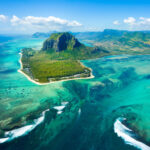
You'll be based in La Preneuse, Black River, on the south west coast of Mauritius.
This is a
small town approximately 40km south of the capital Port Louis. There are
regular buses and taxis to access many of the country's most beautiful
beaches and nature parks.
"I have learnt heaps and
gained invaluable experiences" - Annie Jenkin
SOME CREATURES
YOU'RE LIKELY TO ENCOUNTER
Spinner Dolphin – Stenella longirostris
-
Mauritius:
Spinner dolphins use the bay areas of the West
coast of Mauritius, specifically Tamarin, Black
River and Point Moyenne, for socialising and
resting during the morning. They occur in large
groups averaging 50 animals and are easy to
identify by their high spinning jumps.
-
Description:
There are several forms of
the spinner dolphin the one found in Mauritian
waters is the Hawaiian form with a distinct
tricolour pattern on the body and long black
rostrum or beak. They grow to just less than
2.5m and can weigh up to 78kg. This species of
dolphin tend to move away from the coast in the
late afternoon to feed in deep water on squid
and small fish. Gestation: 10.5 months.
-
Status:
Spinner dolphins are considered abundant but
local populations are vulnerable to human
disturbance and habitat degradation.
Indo-Pacific Bottlenose Dolphin - Tursiops
aduncus (inshore)
-
Mauritius:
In Mauritius these dolphins occur along the
coast behind the reef line, they are usually
seen in small groups, average 6 individuals.
-
Description:
Basically grey colouration which fades
ventrally. Spotting is seen on the stomach of
older animals. These dolphins live for 40 years
or more and grow to 2.5-2.6 meters, weighing
between 180 and 230kg. Bottlenose feed
opportunistically on reef and bottom dwelling
fish and cephalopods (squid and octopus).
Gestation: 12 months.
-
Status:
This species is not considered endangered but
due to its near shore distribution is vulnerable
to many forms of human disturbance.
Common
Bottlenose Dolphin – Tursiops truncatus
(Offshore)
-
Mauritius:
This species has been encountered several times
along the west coast in groups of 5 to more than
50 animals. They are generally travelling and
do not stay long in water less than 50m deep.
No detailed study has been conducted yet on this
species.
-
Description:
This species is often confused with the
Indo-Pacific Bottlenose Dolphin due to very
similar appearance. The Common Bottlenose is up
to a meter larger (up to 3.8m) and generally has
darker colouring and a shorter beak. When the
two species are in the same area the common
bottlenose will generally remain offshore. They
are opportunistic feeders and groups vary
greatly in size depending on their preferred
habitat, pelagic groups will form larger groups
than those found closer to the coast.
-
Status:
The Common Bottlenose Dolphin is considered
widespread and abundant but in specific areas
populations are under threat from habitat
degradation, pollution and conflict with
fisheries.
Humpback Whale (Megaptera novaeangliae)
-
Mauritius:
Humpback whales arrive along
our coast from the end of June and can be seen
until the beginning of November, though
sometimes as late as December. They migrate
from their Antarctic feeding grounds to the
warmer tropical seas in winter to mate and give
birth. These whales are either seen as
individuals, mother-calf pairs or sometimes a
mother and calf with a male.
-
Description:
As the name suggests this species has a hump in
front of the dorsal fin. The body is black on
the back with varying amounts of white on the
flippers and underside. The flippers are very
long compared to any other whale species.
Humpback whales can grow to 16 or 17m and weigh
up to 40 tonne and live for at least 50 years.
-
Status:
In the 20th
Century Humpback whales were hunted extensively
drastically reducing their numbers. Today this
species appears to be recovering but they are
still threatened by human disturbance and
exploitation and discarded fishing equipment
such as nets.
Sperm
Whales (Physeter
macrocephalus)
-
Mauritius:
Sperm Whales can be found in the deep water,
more than 500m, around the coastline of
Mauritius throughout the year and are
concentrated along the west coast.
-
Description:
Sperm Whales are the largest of the toothed
whales reaching 18m and weighing almost 60
tonnes. They have a very large block shaped
head with the blowhole positioned on the front,
left hand side giving an angled blow. The
dorsal fin is low and rounded. In general these
whales are a dark grey with a few white patches
on the ventral surface usually around the lower
jaw. They feed on large squid, rays, sharks and
some fish.
-
Status:
In the past, as with
most of the whales, this species was hunted
extensively. Today the populations of Sperm
whales are slowly increasing but entanglement in
fishing equipment and collisions with ships are
still threats.
Pilot Whales (Globicephala macrorhynchus)
-
Mauritius:
Known to occur off the west and south western
coasts of Mauritius in deeper water, they are
found in groups of 10 to 50 individuals. This
animal is yet to be studied in detail in
Mauritius.
-
Description:
The body is a black or dark brown with a lighter
grey area behind the dorsal fin. The head is
large and rounded. Male Pilot whales can grow
to 7m with the females usually not more than
5m. This species feeds mainly on squid
sometimes taking fish or octopus.
-
Status:
While the overall population of Pilot whales is
thought to be abundant, ongoing hunting and
by-catch are thought to be depleting populations
in areas such as Japan, Indonesia and Sri Lanka.
Melon
Headed Dolphin (Peponocephala electra)
-
Mauritius:
Apart from some sightings no information is
currently available about this species in
Mauritian waters.
-
World Distribution:
Oceanic in the warm tropical equatorial waters.
Very little is known about this species.
-
Description:
The Melon-headed Whale is dark grey or black
with some lighter ventral markings and white or
pink lips. The head is rounded and downward
sloping without a beak. Individuals can grow to
almost 3m and weigh up to 210kg. This species
live in very large groups of several hundred to
more than 1000 individuals and feed on pelagic
fish and squid.
-
Status:
While no specific conservation problem has been
identified for this species, the limited
knowledge about population size and reproductive behaviour is reason for concern and needs to be
addressed in the near future.
"All
in all, a fantastic experience!" - Sandy
Zouzaneas
|
|
|


Got any questions? Please
email us:
info@travellersworldwide.com


Olivier, the project’s research officer


The research boat

Spinner Dolphin

Indo-Pacific Bottlenose Dolphin

Common Bottlenose Dolphin

Humpback Whale

Sperm Whale

Pilot Whales

Melon Headed Dolphin
Got any questions? Please
email us:
info@travellersworldwide.com
|