Travellers voluntary projects overseas for gap years, career breakers, grownup gappers, mature gappers and retired people.

+44 01903 502595
Email Us
Get a brochure

  You are here >

Where would you like to go?


Search this website


Travellers Sponsorship Beneficiary Wins 2007 International Children's Peace Prize! - Click here to read more...


ABOUT ZIMBABWE

Zimbabwe is a beautiful country. And it's the only place where you can walk with free roaming lions on a game reserve.

Over a million tourists a year visit Zimbabwe's renowned attractions, like the majestic Victoria Falls, which is probably Zimbabwe's most famous tourist spot. Then there are the medieval Zimbabwe Ruins, the Matapos National Park with its incredible rock formations. But for the conservation-minded, you cannot miss Hwange (Wankie) Game Reserve - it's awesome!

Bulawayo (the closest city to our projects) is the second biggest city in the country. It has a typically friendly atmosphere with wide, tree-lined streets, pavement cafes and a mixture of modern and old shops and buildings.

Extremely Close-Up and Personal with Lions: Travellers offers the only project in the world (to our knowledge) where you can take lion cubs for a walk through a Game Reserve - a unique and unbelievable experience!

On this page:


ABOUT ZIMBABWE:
Previously known as Rhodesia, Zimbabwe lies between two great African rivers, the mighty Zambezi River in the north, and the Limpopo River in the south. Covering an area of about 375,830 square kilometres, it is best known by tourists for the Victoria Falls, a great waterfall much larger than Niagara Falls.

Zimbabwe as a tourist destination is once again increasing in popularity with lots of overseas tourists as well as thousands of African tourists flocking there each year. It's a very popular stop-off point for 'overlanders' doing trips through Africa in safari-type trucks. The capital, Harare, is modern, bright and bustling, but my favourite city is Bulawayo, where the people are particularly friendly and the atmostphere is typically laid-back African.

Zimbabwe is a landlocked country at the base of the African continent. Its neighbours are Mozambique (to the east), South Africa and Botswana (to the south and west), and Zambia (to the north). Zimbabwe lies on a high plateau, and its terrain consists primarily of grasslands bordered on the east by mountains.

The mighty Zambezi River forms the northeastern border and here is where you'll find the incomparable spectacle of Victoria Falls and the magnificent expanse of Lake Kariba. Both of these are truly not to be missed - being out in the middle of the river and watching a herd of elephants wallowing in the shallows along the banks is one of life's great experiences.

The Zambezi has become one of the world's best water adventure travel destinations because of the outstanding whitewater rafting in the Zambezi Gorges below the Falls, as well as excellent canoeing and kayaking above them.

Zimbabwe's system of National Parks and Reserves is extensive, well-organized, and notable for the range of safari experiences and game viewing, ranging from open vehicles, night game drives; walking safaris and boat safaris in motor launches, canoes, kayaks, and even houseboats.

Climate:
As Zimbabwe is south of the equator, the seasons are the reverse of those in the northern hemisphere with mid-summer at Christmas and winter lasting from May to August. Average temperatures in the area where Travellers projects are based are given below, but please note that it is considerably warmer all year round in the lower-lying areas such as Kariba, Victoria Falls, Hwange, Gonarezhou and the Zambezi Valley.

In summer, daytime temperatures average 25 - 30C during the day, with October being the hottest month. Temperatures in the lower-lying areas can be much hotter, where temperatures can be well into the 30's. It is advisable to wear a hat out of doors.

Winter days are generally dry and sunny with daytime temperatures averaging 15 - 20C. Night-time temperatures can be very cold and can sometimes drop below freezing in the city of Gweru, as it is one of the coldest places in Zimbabwe. The rainy season is from November to March.

To see what Support & Backup we provide in our countries, please click here.

      .

About Zimbabwe and the lion breeding and game reserve projects you can do there

PROJECTS YOU CAN DO IN ZIMBABWE

Walking With Lions Project: Extremely close encounters with Lions on this Lion Breeding Project located in a Beautiful Game Reserve. This is the only project in the world where you can take lions for a walk through a Game Reserve - a unique and unbelievable experience!

 Hwange Game Park Conservation Project: Help to protect and conserve one of Africa's few remaining wildlife sanctuaries. You'll work in one of Africa's premier game reserves where there are huge herds of elephant, buffalo, plains-game, lion and leopard.

 Black Rhino Conservation: This project is a World Wildlife Fund (WWF) endorsed programme for the conservancy of the Midlands black rhino. The project is based in a wildlife sanctuary area in the heart of the Zimbabwe Midlands.

 Volunteer Feedback: Read what our volunteers have to say about their Zimbabwe Proogramme

A BRIEF HISTORY

During its heyday, the area known as Great Zimbabwe was the capital of a Shona trading empire that subsequently collapsed for reasons that remain unknown. By the middle of the19th century, with European influence still slight, the region's Shona states had been defeated by an invading Ndebele army from the south. Ndebele power didn't last long, however.

In 1890, the fortune-hunting Cecil Rhodes arrived at the head of a private army of settlers and commenced to conquer what he thought might be a rich gold-producing region. By 1897 the area had been completely subdued.

In 1923 Rhodesia became a self-governing British colony, completely controlled by the white settlers. For much of the last half-century Zimbabwe's history has been that of the long struggle to end white rule. Finally, in 1979, a new constitution that provided for democratic majority rule was established.

Back to Top

VICTORIA FALLS - WORLD FAMOUS AND AWESOME!
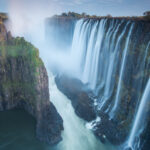
To begin with, the Victoria Falls are legendary - a ferocious curtain of water 1,700 metres wide that plunges deep into the gorge of the mighty Zambezi River. Upstream from the Falls the river is placid and tranquil. Zambezi National Park preserves 56,000 acres along the river and there are fishing camps along the shore that take anglers out on river to catch tiger fish. Wildlife can be viewed in cruises along the river or on explorations into the park's interior.

Downstream from the falls, the river offers spectacular whitewater rafting. Adventures range from a day or two to a spectacular week of rafting all the way to Lake Kariba. This huge inland sea is adorned with submarine forests, open skies and spectacular sunsets.

David Livingstone was the first European to visit the Falls (this was in 1855) and he named them in honour of his queen.

The exciting viewing of Victoria Falls
"Thundering smoke" - that's what the local people of Zimbabwe call Victoria Falls. At the end of the rainy season, the immense amount of water thundering over the edge of the Falls literally forms an enormous cloud of thin spraying mist. You're absolutely drenched long before you reach the Falls themselves. The sound of thundering water falling over the 2 km wide Falls is overwhelming and can be heard from up to 25 miles away at times.

The walk to and from the Falls is an amazing experience in itself. It is surrounded by jungle and you can spot wild game such as waterbuck through the leaves. If you find a quiet spot to sit and view the Falls and absorb the beautiful surroundings, you feel totally at one with Nature - both dwarfed and overwhelmed and at the same time powerfully inspired - it's a wonderful feeling! 

The walk along the Zambezi above the Falls is excellent and is packed with wildlife. You may see warthog, crocodile, hippo, and even elephant, buffalo and lion.

Activities around the Falls
There are all sorts of activities offered at Victoria Falls, including bungee jumping, small plane flights over the Falls, and raft trips to the Boiling Pot at the base of the Falls where the water cascades down into the river. In addition, Victoria Falls is also the centre for some of the best safari and adventure opportunities in Africa. Above the Falls, outstanding canoe and kayaking safaris are available, offering one of the most exciting and memorable ways to experience both the Zambezi and the abundant game of Zambezi National Park.

Below the falls, the Zambezi becomes a whitewater rafting paradise. The rafting trips that run through the river's gorges are internationally known as the most exciting, and least dangerous, to be found anywhere.
.

Lake Kariba and the Kariba Dam
Further east, and further downstream from Victoria Falls, is located this enormous (almost 2000 sq. mi./5200 sq. km) man-made lake. Formed in 1958 by the damming of the Zambezi at Kariba, the lake is now an attraction in its own right. Its scattered islands, clear, deep waters, and adjoining game reserve complement each other admirably. The reserve, Matusadona National Park, was begun as a refuge for animals saved from the rising waters of the lake itself. Today, its abundant game gathers along the lake shore, particularly in the dry months, where it is easily viewed from the water. Zimbabwe's fine small houseboat lodges are located here, and the Lake also serves as the starting point for canoe safaris to Mana Pools National Park.

Mana Pools National Park
The next major attraction along the shores of the Zambezi is Mana Pools, a region in which the Zambezi slows and spreads out into a multitude of small ponds and pools. During the dry season, the Mana Pools attract a scarcely believable abundance of wildlife, including lion, leopard, zebra, and hippo in addition to an unusually wide variety of antelope species.

Canoe safaris to and through the Mana Pools during this time of year can be absolutely stupendous experiences. Another attraction of this park is that walking safaris are the only other means of touring allowed in certain sections, ensuring not only quiet but also many fewer signs of other visitors.


The very impressive Kariba Dam. Plane trips to view the Dam are very popular.

Back to Top

BULAWAYO - "THE CITY OF KINGS"

Bulawayo is Zimbabwe's second largest city with over a million people. Located in the south-west, Bulawayo is the hub of the province of Matabeleland, which comprises the whole western Zimbabwe from the South African border in the south to Victoria Falls in the north.

The city has wide, tree-lined streets and is surrounded by beautiful parks, a legacy of Cecil John Rhodes. The exceptionally wide streets were designed to allow a wagon and span of 16 oxen to do a U-turn in the road! They have been laid out on a neat grid pattern, making exploration of the city very easy - reminiscent of some cities in Australia and The United States.

Another feature of the city streets that makes Bulawayo easily identifiable is the lovely lamp-posts  There are also many examples of early Victorian buildings which are maintained as heritage sites. A lovely place to sit outside and watch Bulawayo go by is the pavement cafe on Fife Street called Haefeli's - great coffee, great cakes and pastries and a relaxed cosmopolitan atmosphere!

Other places of interest include the country's main museum, the natural history museum, a railway museum, the Bulawayo Art gallery (which is housed in a most attractive turn of the century building), theatres, the Mzilikazi Arts & Crafts Centre, good hotels and one of the finest caravan and camping parks in Zimbabawe. It is also home to the Chipangali Wildlife Orphanage.

Since 1894 Bulawayo has grown to become the country's most attractive modern city. But it retains its historical characteristics, making it a unique centre of African heritage Consequently, the city, which is known as the City of Kings, boasts a rich diverse cultural background and it owes all this to the cross-section of ethnic groups which have lived together peacefully for many years.

Bulawayo belongs to that short list of cities that has a large city infrastructure coupled with a small town atmosphere.  It has been likened to an oasis town on the edge of the Kalahari. Botswana is just over the border.


The wide, tree-lined streets with their distinctive lamp posts are a feature of Bulawayo

Bulwayo, a mix of old and new that lives happily side-by-side

GREAT ZIMBABWE (also known as the ZIMBABWE RUINS)

Entrance to the Great Zimbabwe ruins
The entrance to Great Zimbabwe, seen from the inside

The Hill Complex

This complex of ruins from which the country took its new name of 'Zimbabwe', is one of the country's greatest historical and cultural attractions. Great Zimbabwe is the largest ruins in Africa and covers almost 1,800 acres.

"Sited on an open wooded plain surrounded by hills, the ruins comprise the vast Great Enclosure complex, and on a nearby kopje the Hill Complex, a veritable castle of interlocking walls and granite boulders, while all around in the valley lie a myriad other walls. The ruins feature an array of chevron, herringbone and many other intricate patterns in its walls ... despite the dry-stone technique used in Great Zimbabwe's construction (no mortar binds the stone blocks), the complex has endured for seven centuries." [Zimbabwe, Globetrotters Travel Guide,]

When the Ruins were discovered by European explorers in 1870, they thought it was the site of King Solomon's mines - the result was a frantic rush to search for gold ... with no success whatsoever!

To read more about Great Zimbabwe, click here

Back to Top


Man and Nature - aloes among the ruins

The Great Enclosure seen from the Hill Complex

THE MATOPOS NATIONAL PARK

The Matapos Hills in Zimbabwe

Less than an hour's drive from Bulawayo is the ancient Matopos Hills, granite outcrops in Matopos National Park. Cecil Rhodes was so bewitched by the mysterious formations that he chose it as his burial place.

As you leave the city, you begin to see outcrops of granite. These increase in number and size so that by the time you enter the Park, you're surrounded by a dramatic and enveloping scenery that is unique and extraordinary. There is a beautiful lake and many camping areas with brick-built rooms and facilities - a lovely place to spend a few days.

HOW SAFE IS ZIMBABWE?


Haefeli's Cafe in Bulawayo (they make extremely good coffee!)

Back to Top

According to the local people, very safe. When Travellers went to Zimbabwe to check the safety issues for ourselves, we were constantly told (by visitors and locals alike) that Zimbabwe is one of the safest countries in Africa. The two members of the Travellers team who initially inspected the safety issues had been to Zimbabwe many years before and had a comparison between 'then' and 'now'. They both felt very comfortable walking around the streets of Bulawayo and Victoria falls. They also felt comfortable and safe when driving into and around the rural areas. Since this time, another member of staff has been to Zimbabwe to inspect the projects - we feel happy that our projects are in safe working areas.

Travellers always keeps up-to-date on the safety and stability of all our countries because many of them are third world countries. We are in constant touch with our staff and project leaders on the ground and with our volunteers in all our countries, so we always know exactly what is going on. We are also constantly kept informed by the Foreign & Commonwealth Office on the political and safety situations in all the countries we work in. Please have a look at http://www.fco.gov.uk

In a major situation, the second we feel that there is a danger to our volunteers, we act immediately to protect them and get them out of the country (and we have never had to withdraw people from a country yet, the only exception has been getting our volunteers out of China during the SARS epidemic). Our in-country Managers and Organisers are all well versed in what to do in the event of an emergency.

In our opinion, there are pockets of unrest, but this is generally a safe country. We would however make the same proviso as we make for all our destinations --- use your common sense, exactly the same as you would do at home. In other words, for example don't walk around on your own at night, particularly if you're a young girl, and always get local advice on where to go and where not to go.

Safety on our Projects
Our Lion Breeding Project takes place on a Game Reserve a few kilometres from Gweru and about 1.5 to 2 hours' drive outside Bulawayo.
It is a huge complex with unbelievably good facilities and is renowned for being very safe. 

The Park/Game Reserve is completely fenced in, with a large number of staff, some of whom live on-site and others who travel into work each day from Gweru and some of the outlying villages. They have been working there for over 20 years and have an average of 18 overland trucks visiting the Park every month. This means about 250 - 300 foreign visitors, besides any other independent travellers.

The Lion Breeding project in Victoria Falls is based in one of the tourist capitals of the world and as such is deemed to be a safe destination.

Our Hwange Project is based on the outskirts of the National Park and is in a very isolated setting. A danger here is wild animals which frequent the area, but with a 24 hour armed security this keeps this threat at bay!

For your peace of mind, though, we do take a couple of added precautions:

  • As we do on all our placements, we meet you at the Airport (in this case Bulawayo or Victoria falls where applicable) and take you to the Project. We also take you back to the airport at the end of your stay.

  • As we would prefer it if our volunteers didn't travel around Zimbabwe on their own and unaccompanied, we have arranged for the Park to provide excursions to different places such as Victoria Falls and Kariba Dam. These are optional extras which will enable you to explore these sights in comfort and safety, accompanied by an Park employee guide.

If you'd like to find out more about the country or the projects, please telephone us on +44 (0)1903 502595 and speak to either Trevor Snelling or Jennifer Perkes - they'd be delighted to answer any questions you may have.


Travellers is a Founder Member of the Year Out Group

Suite 2A, Caravelle House, 17/19 Goring Road, Worthing,
West Sussex, BN12 4AP, England
Tel: +44 (0)1903 502595    Fax: +44 (0)1903 708179

Email: info@travellersworldwide.com


Web site designed by ITDesigners: www.itdesigners.com
Copyright © 1999-2007 TravelQuest Limited;
Last modified: April 24, 2008